
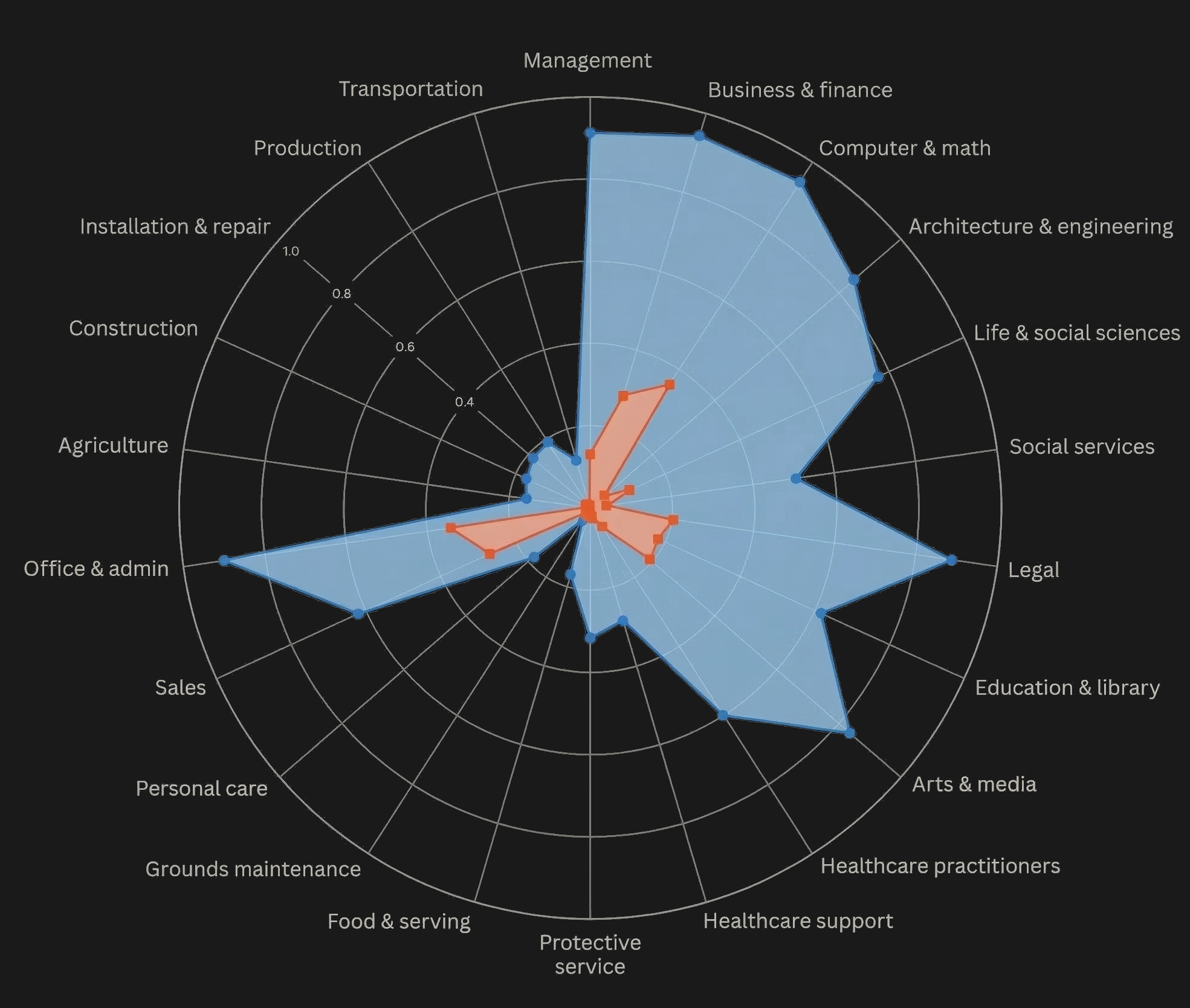
The recently
released report by Anthropic on the labour market impact of AI makes
for ... interesting reading.(Anthropic 2026).
Anthropic’s report is focused on the US job market. I map
the findings to Malta’s.
Malta’s economy is heavily exposed to AI displacement risk.
| AI Exposure Tier | Estimated Workers | Share of Workforce | Key Sectors | Policy Priority |
|---|---|---|---|---|
|
HIGH
(>20% observed exposure)
|
91,500 | 27.1% | ICT/iGaming, Financial Services, Professional Services, Admin/Support | CRITICAL: Reskilling programs, AI literacy training, SME adoption support. Monitor youth hiring rates in these sectors. |
|
MEDIUM
(8–20% observed exposure)
|
98,000 | 29.1% | Public Admin, Education, Wholesale/Retail, Arts/Entertainment, Management | IMPORTANT: AI augmentation strategy. Focus on productivity gains rather than displacement. Upskill for human+AI collaboration. |
|
LOW-MEDIUM
(3–8% observed exposure)
|
53,000 | 15.7% | Healthcare, Architecture/Engineering, Social Services | MODERATE: Monitor for rising automation in diagnostic/analytical subtasks. Support incremental AI adoption. |
|
LOW
(<3% observed exposure)
|
85,734 | 25.4% | Tourism/Hospitality, Construction, Transport, Manufacturing, Personal Services | LOW PRIORITY for displacement but OPPORTUNITY for efficiency gains. These sectors face labour shortages that AI cannot yet address. |
|
NONE/MINIMAL
|
9,000 | 2.7% | Agriculture, Fishing | No action needed. Physical outdoor work remains beyond AI scope. |
In Anthropic’s data (Computer and Math at 33% observed / 94% theoretical, Business and Financial at 26% / 86%, Office and Admin at 24% / 90%) map directly to Malta’s largest and fastest-growing employment sectors: ICT, financial services, professional services, and admin/support services.
The iGaming sector a unique pillar of the economy employing 10,000+ people across software development, customer support, compliance, and marketing — sits squarely in the crosshairs. Computer programmers (74.5% observed exposure), customer service reps (70.1%), and financial analysts (65%) are the top-exposed occupations nationally.
The below table maps the SOC occupational categories used by Anthropic to the ISCO-08 standard used by the NSO.
| SOC Major Group (Anthropic Report) | Theoretical Exposure (β) | Observed Exposure | ISCO-08 Major Group | ISCO Group Name | Malta Employment (Q3/2025 est.) | Malta Share of Total | Avg Monthly Salary (€) | AI Exposure Tier | Malta-Specific Notes |
|---|---|---|---|---|---|---|---|---|---|
| Computer & Mathematical | 94% | 33% | 2 | Professionals (ICT subset) | 18,500 | 5.5% | €2,800 | HIGH | Includes igaming software devs, IT professionals. Malta has ~10K igaming employees, many in tech roles. Computer Programmers top Anthropic's list at 74.5% observed exposure. |
| Business & Financial Operations | 86% | 26% | 2 | Professionals (Business/Finance subset) | 28,000 | 8.3% | €2,900 | HIGH | Financial analysts (65% exposed), accountants, compliance officers. Malta's financial services sector is a major employer. Shortage occupation per EURES. |
| Office & Administrative Support | 90% | 24% | 4 | Clerical Support Workers | 30,000 | 8.9% | €1,650 | HIGH | Data entry keyers (67% exposed), secretaries, general office clerks. Large cohort in Malta across all sectors. Customer service clerks noted as surplus occupation. |
| Management | 70% | 18% | 1 | Managers | 33,000 | 9.8% | €3,467 | MEDIUM | Malta's manager category is large given SME-heavy economy. Avg salary €3,467/month (highest). Moderate exposure as strategic/interpersonal tasks less automatable. |
| Arts, Design, Entertainment, Sports, Media | 75% | 17% | 2 | Professionals (Creative subset) | 8,000 | 2.4% | €2,200 | MEDIUM | Writers, graphic designers, content creators. igaming marketing teams heavily represented. Copywriters show high augmentation patterns. |
| Legal | 80% | 14% | 2 | Professionals (Legal subset) | 5,500 | 1.6% | €3,100 | MEDIUM | Legal professionals in shortage per EURES. Compliance roles critical to igaming/fintech. Theoretical exposure high but practical deployment limited by regulation. |
| Education, Training & Library | 65% | 12% | 2 | Professionals (Education subset) | 22,000 | 6.5% | €2,400 | MEDIUM | Teachers and lecturers. Large public sector employer in Malta. Low automation risk — AI augments lesson planning but doesn't replace classroom management. |
| Sales & Related | 60% | 15% | 5 | Service & Sales Workers (Sales subset) | 25,000 | 7.4% | €1,800 | MEDIUM | Retail sales, real estate agents, insurance sales. Service & sales is the largest ISCO group in Malta. Partial exposure through automated customer interactions. |
| Healthcare Practitioners & Technical | 50% | 8% | 2 | Professionals (Health subset) | 15,000 | 4.4% | €2,700 | LOW-MEDIUM | Doctors, nurses, pharmacists. Healthcare is a growing sector in Malta (+1,426 FT jobs YoY in May 2025). Physical/diagnostic tasks limit AI displacement. |
| Community & Social Service | 55% | 7% | 2 | Professionals (Social subset) | 5,000 | 1.5% | €2,100 | LOW-MEDIUM | Social workers, counselors. Human-centric roles with limited automation potential. |
| Life, Physical & Social Science | 70% | 10% | 2 | Professionals (Science subset) | 3,000 | 0.9% | €2,600 | MEDIUM | Researchers, environmental scientists. Small but growing in Malta's pharma/biotech sector. |
| Architecture & Engineering | 65% | 9% | 2 | Professionals (Engineering subset) | 8,000 | 2.4% | €2,700 | LOW-MEDIUM | Civil engineers, architects. Construction is a major Malta sector. Physical site work limits AI impact. |
| Protective Service | 30% | 3% | 5 | Service & Sales Workers (Protective subset) | 7,000 | 2.1% | €2,000 | LOW | Police, security guards, military. Physical presence required. Minimal AI exposure. |
| Food Preparation & Serving | 20% | 2% | 5 | Service & Sales Workers (Food subset) | 18,000 | 5.3% | €1,400 | LOW | Chefs, waiters, bartenders. Tourism-driven in Malta. Dishwashers, bartenders have zero observed exposure per Anthropic. |
| Healthcare Support | 35% | 4% | 3 | Technicians & Assoc. Professionals (Health subset) | 8,000 | 2.4% | €1,700 | LOW | Nursing assistants, home health aides. Physical care tasks not automatable. |
| Construction & Extraction | 15% | 1% | 7 | Craft & Related Trades Workers | 20,000 | 5.9% | €1,600 | LOW | Construction workers, electricians. Building trades in surplus per EURES. Purely physical work. |
| Installation, Maintenance & Repair | 25% | 3% | 7 | Craft & Related Trades Workers (Maint.) | 10,000 | 3.0% | €1,700 | LOW | Motorcycle mechanics have zero exposure per Anthropic. Hands-on diagnostic/repair work. |
| Production | 30% | 5% | 8 | Plant & Machine Operators | 12,000 | 3.6% | €1,500 | LOW | Factory workers, machine operators. Malta's small manufacturing sector. |
| Transportation & Material Moving | 20% | 2% | 8 | Plant & Machine Operators (Transport) | 12,000 | 3.6% | €1,500 | LOW | Bus/truck drivers, delivery workers. Physical movement tasks. |
| Building & Grounds Cleaning/Maint. | 10% | 1% | 9 | Elementary Occupations | 15,000 | 4.4% | €1,336 | LOW | Cleaners, landscapers. Dressing Room Attendants have zero exposure. Elementary occ. have lowest salary in Malta (€1,336). |
| Farming, Fishing & Forestry | 10% | 0% | 6 | Skilled Agricultural Workers | 3,000 | 0.9% | €1,400 | NONE | Very small in Malta. Physical agricultural work like pruning trees is explicitly noted as beyond AI's reach. |
| Personal Care & Service | 30% | 4% | 5 | Service & Sales Workers (Personal subset) | 12,000 | 3.6% | €1,500 | LOW | Hairdressers, childcare, fitness trainers. Personal service workers in shortage per EURES. Physical/interpersonal roles. |
Top 10 exposed occupations
| Rank | Occupation (per Anthropic) | Observed Exposure | Malta Estimated Workers | Malta Relevant Sector(s) | Avg Salary Range (€/mo) | Malta Impact Assessment |
|---|---|---|---|---|---|---|
| 1 | Computer Programmers | 74.5% | 5,000 | igaming, IT services, fintech | 2,500–3,500 | Malta's igaming sector employs thousands of developers. 74.5% task coverage means AI tooling (Cursor, Copilot, Claude Code) is already touching ¾ of programming tasks. Early-career dev hiring may slow as per Anthropic's youth hiring data. |
| 2 | Customer Service Representatives | 70.1% | 8,000 | igaming, telecoms, banking, outsourced services | 1,400–1,800 | Massive in Malta — call centres and igaming support. 70.1% coverage driven by API-automated inquiry handling. Customer service clerks already in surplus per EURES Malta. Highest near-term displacement risk. |
| 3 | Data Entry Keyers | 67.0% | 3,000 | Admin services, financial services, government | 1,200–1,500 | Primary task (reading source docs, entering data) sees significant automation. These roles are already declining globally. Malta's admin/support sector is large. |
| 4 | Financial Analysts | 65.0% | 2,500 | Financial services, igaming (revenue analytics), consulting | 2,800–3,500 | Malta's financial services hub means significant concentration. Report generation, data analysis, and trend identification all within AI capability. |
| 5 | Bookkeeping, Accounting & Auditing Clerks | 60.0% | 4,000 | All sectors (cross-cutting) | 1,800–2,400 | Transactional accounting tasks highly automatable. Malta's VAT compliance, quarterly reporting cycles make this a prime AI augmentation/automation target. |
| 6 | Market Research Analysts | 58.0% | 1,500 | igaming, professional services, marketing agencies | 2,200–3,000 | Survey design, data analysis, report writing all within AI scope. igaming companies rely heavily on market intelligence. |
| 7 | Technical Writers | 56.0% | 800 | IT/igaming, pharma, professional services | 2,000–2,800 | Documentation tasks show high directive (automated) patterns in Anthropic data. API docs, compliance manuals, user guides all AI-augmentable. |
| 8 | Insurance Underwriters | 52.0% | 1,000 | Insurance sector | 2,500–3,200 | Risk assessment and policy evaluation tasks have high theoretical and observed exposure. Malta's insurance sector is concentrated. |
| 9 | Paralegals & Legal Assistants | 50.0% | 1,200 | Legal services, igaming compliance, financial regulation | 1,800–2,500 | Document review, legal research, contract drafting all AI-capable. Malta's regulatory-heavy igaming/fintech environment creates high demand but also high AI applicability. |
| 10 | Web Developers | 48.0% | 3,000 | igaming, e-commerce, digital agencies | 2,200–3,000 | Frontend and basic web development tasks increasingly automated. Full-stack roles in igaming platforms particularly exposed. |
Disclaimer I ran Anthropic’s report through Claude + my prompting. I am not a professional statisician.
But... the data is indicative enough start some serious
policy conversations.The challenge will be recognizing the charlatans
pretending they understand AI.
Anthropic ‘Labor Market Impacts of AI’ report (Massenkoff & McCrory, March 5, 2026) — provides observed exposure scores for ∼800 US SOC occupations based on actual Claude usage data from the Anthropic Economic Index.
NSO Malta Labour Force Survey Q3/2025 (published Dec 11, 2025) — provides Malta’s employment totals, occupational distribution (ISCO-08), industry distribution (NACE Rev.2), salary data, unemployment rates.
NSO Malta Registered Employment data (May 2025) — provides NACE-level breakdown of full-time and part-time employment from administrative records (Jobsplus).
Cedefop 2025 Skills Forecast for Malta — provides forward-looking occupation and sector employment projections to 2035.
EURES Malta Labour Market Information (2024) — provides occupation shortage/surplus data.
Eurostat Labour Force Survey data (2024) — provides EU-comparable employment rates and occupational breakdowns.