
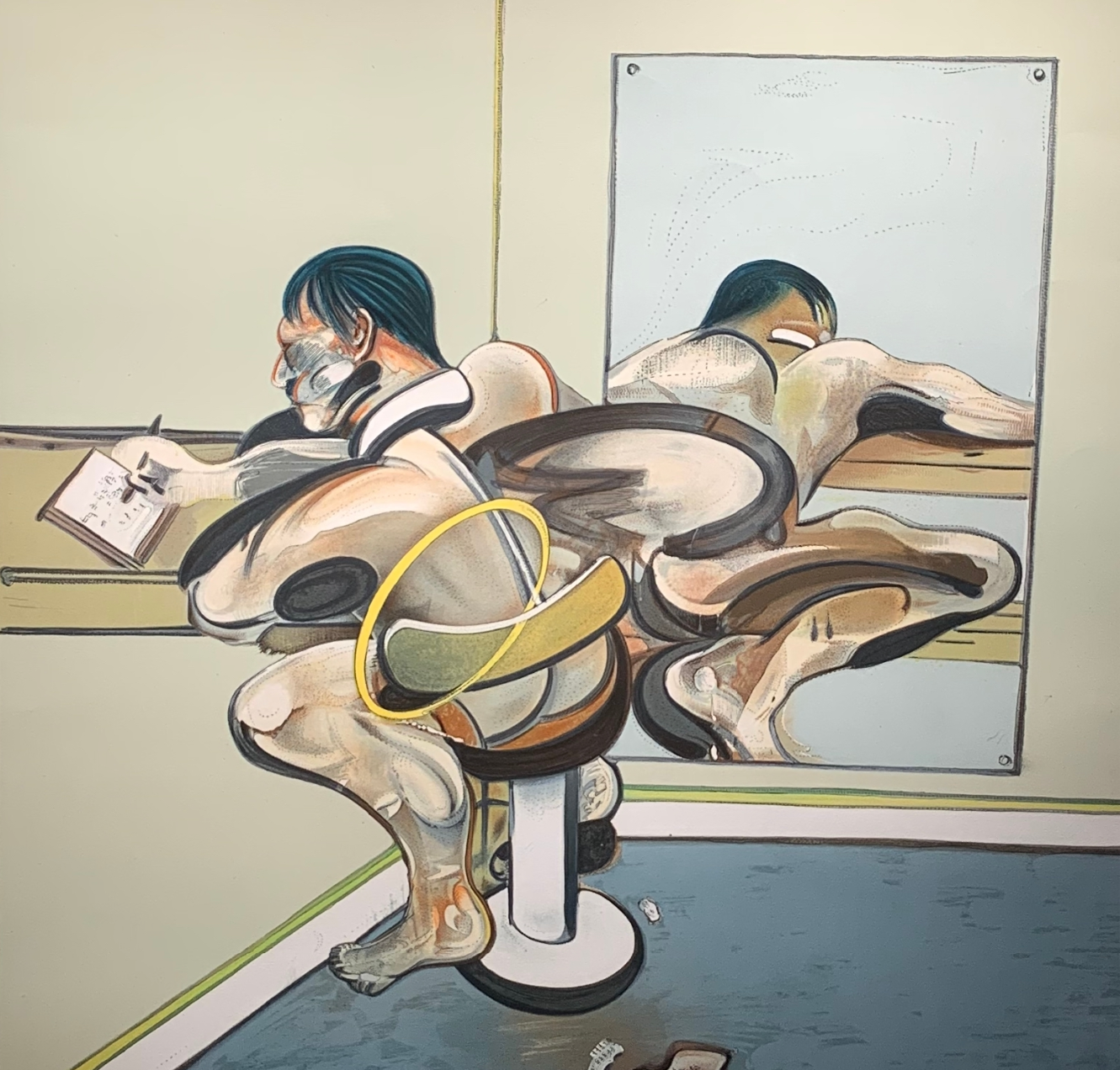
If machines can think, then they can communicate.
“language is not the world ... these machines do not directly anticipate the world. these machines anticipate how we would talk about our anticipation of the world” John Vervaeke - https://www.youtube.com/watch?v=HAJclcj25uM&t=420s
"To know a living language is to be able to speak and understand the language."
Thinking is not understanding or grasping.
"intentionality of thought"
We can think of what is the case, and of what is not the case.
One can be interrupted while thinking, but not while understanding. One can resume thinking.
Thinking: reasoning, reflecting.
Imagining: thinking up possibilities, thinking falsely.
Musing Remembering Taking a cogitative stand: inferring/deducing, judging, concluding.
A cogitative attitude: believing that, opining that, estimating, assuming, taking for granted.
Thinking of…
Acting with thought: attentively, intelligently, after deliberation,
with relevant considerations, mechanically. (Hacker
2013, 363).
Reasoning: "We reason from premises, derive conclusions from evidence, draw inferences from data, deduce consequences."
"Thinking, in this sense, is purposive, goal-directed. Depending upon its upshot, thinking can be successful or fail of its objective. It may be engaged in with concentration, tenacity and determination. It can be intuitive or discursive. If it is discursive, it may be methodical, systematic and rigorous. It may be intelligent, brilliant or pedestrian – hence one may be good or poor at it. At its most mechanical, it involves calculating or computing in accordance with familiar rules."
"thought may be conventional in style, going down well-trodden paths competently... Or it may be original, pioneering new routes and exploring new possibilities."
ruminating: "reflecting to ruminating, musing, daydreaming and idle thinking." "These progressively move away from the purposive problem-oriented character of reasoning."
"voluntary and intentional, as well as involuntary, and in certain cases, compulsive (as when one can’t help thinking about Jack or Jill)."
"To think what it would be like to V is to imagine V-ing." "To think what will happen if ... is to imagine future possibilities. To have imagined something differently is to have thought of it differently."
Thought and Action: "one may not only think how to do something, and think of doing something – one may do it with or without thought.
To do something with thought, to think of what one is doing while one is doing it, is to concentrate on what one is doing, to attend to the task at hand. Mechanical tasks can be engaged in without thought."
Thought and speech: "To speak without thinking does not mean speaking without an accompanying inner activity of thinking. t may be to speak without taking into account factors... To speak thoughtlessly may be to speak insensitively, tactlessly or inconsiderately."
Thinking and belief: "One may think that things are so, just as one may believe that they are. One may tentatively or hesitantly think or believe things to be so, or that things are so. Both ‘think’ and ‘believe’ function as the default position in the absence of knowledge."
Thinking and meaning: thinking of someone or something, to bring them to mind, or, when asked "who were you thinking of when you said X?" in the sense of "who did you mean?" "who were you referring to?" "who did you have in mind?"
“To be responsive to one’s perceived environment in pursuit of one’s
goals is a form of cognitive teleological behaviour.”(Hacker
2013, 394).
"To act ‘in the light of reasons’ presupposes a grasp of therefores and becauses, the sole behavioural expression of which is linguistic. A being can act for a reason only if it can apprehend something as a reason – as a warrant justifying or explaining that for which it is a reason. A dog may apprehend a break in the path along which it is sprinting, and accordingly leap over it. It does not follow that its reason for jumping was that there was a chasm in the path, although the reason it jumped was that it perceived the chasm. The dog can neither justify nor explain its action by reference to there being a gap in the path into which it would have fallen but for leaping. "
"The fundamental notion that needs to be invoked in elucidating the idea of a reason is that of reasoning. A creature can do things for a reason only in so far as it can reason – deduce consequences from assumptions, infer explanations from data, derive conclusions from evidence. To come to a conclusion on the basis of reasons presupposes the ability to weigh different considerations for and against something’s being so, or for and against doing something. That in turn requires the ability to judge that this course of action is better than that one, because ... In order to be able to act or think that something is so for a reason, one must be able to deliberate, to make reasoned choices in both thought and action and hence to give justifications and explanations.
In short, one must be able to answer the question ‘Why?’"
"An animal may behave intelligently – solve its problem in behaving.
But could it solve a problem without behaving? It is unclear what this
means in this context. Could a thought of how to V occur to an animal
and be rejected? Could a thought how to V occur to it in the absence of
an opportunity to V, and be registered for future use?" (Hacker
2013, 395).
“Animals cannot deliberate, ruminate or reflect, let alone draw inferences, derive conclusions or deduce consequences – only recognize, associate, learn and anticipate.”